What Is Email Deliverability?
Email Deliverability is the measure of how successfully your emails reach recipients' inboxes rather than being blocked, bounced, or filtered to spam. It's influenced by many factors, but authentication through DMARC has become one of the most critical.
Understanding the DMARC-Deliverability Connection
To understand why DMARC matters for deliverability, you need to know how mailbox providers evaluate incoming email:
How Mailbox Providers Decide
- Authentication: Is this email actually from who it claims to be from?
- Reputation: Does this sender have a history of sending legitimate email?
- Content: Does the email look like spam?
- Engagement: Do recipients open and interact with emails from this sender?
DMARC directly impacts the first two factors and indirectly improves the others. Run a free domain check to see how your authentication stack measures up.
10 Ways DMARC Improves Deliverability
1. Establishes Domain Authentication
DMARC builds on SPF and DKIM to create a complete authentication framework. When your emails pass DMARC authentication:
- Verification: Receiving servers know your emails are legitimate
- Trust Signal: Your domain identity is verified cryptographically
- Provider Confidence: Mailbox providers trust emails from your domain more
Impact: Authenticated emails are significantly more likely to reach the inbox than unauthenticated ones. Major providers like Gmail and Microsoft prioritize authenticated mail.
2. Protects Your Sender Reputation
Your sender reputation is a score mailbox providers use to determine how trustworthy your emails are. DMARC protects this reputation by:
- Blocking Spoofing: Prevents spammers from sending fake emails as your domain
- Stopping Phishing: Protects your brand from being used in attacks
- Association Control: Ensures only legitimate emails are associated with your domain
Impact: When spoofed emails don't reach recipients, your domain doesn't get blamed for spam. This preserves your hard-earned sender reputation. Check if your domain is already on any blacklists with our blacklist checker.
3. Reduces Spam Folder Placement
Emails that fail authentication are often filtered to spam. With DMARC properly configured:
- Consistent Authentication: Your legitimate emails always pass checks
- Positive Signals: Spam filters see authentication as a trust indicator
- Inbox Placement: Recipients actually see your emails where they expect them
Impact: Organizations implementing DMARC often see a 5-10% improvement in inbox placement rates.
4. Builds Trust with Major Email Providers
Google, Microsoft, Yahoo, and other major providers have publicly advocated for DMARC adoption. They reward domains that implement it properly:
- Gmail: Shows verified sender indicators and prioritizes authenticated mail
- Microsoft: Uses DMARC in spam filtering algorithms
- Yahoo: Was an original DMARC specification author and enforces strictly
Impact: These providers handle billions of emails daily. Their trust translates directly to better deliverability.
5. Enables BIMI Implementation
BIMI (Brand Indicators for Message Identification) displays your logo next to your emails in supporting inboxes. But BIMI requires:
- DMARC Enforcement: Policy of
p=quarantineorp=reject - Consistent Authentication: Emails must pass DMARC consistently
- VMC Certificate: Verified mark certificate for full support
Impact: BIMI increases email open rates by 10-40% by providing visual brand recognition and trust signals. Ready to get started? Use our BIMI generator to create your record, and BIMI lookup to verify your setup.
6. Provides Visibility into Email Ecosystem
DMARC reports reveal what's happening with your email, enabling proactive fixes:
- Source Discovery: Find all services sending email as your domain
- Issue Identification: Spot authentication failures you didn't know existed
- Threat Detection: See unauthorized use of your domain
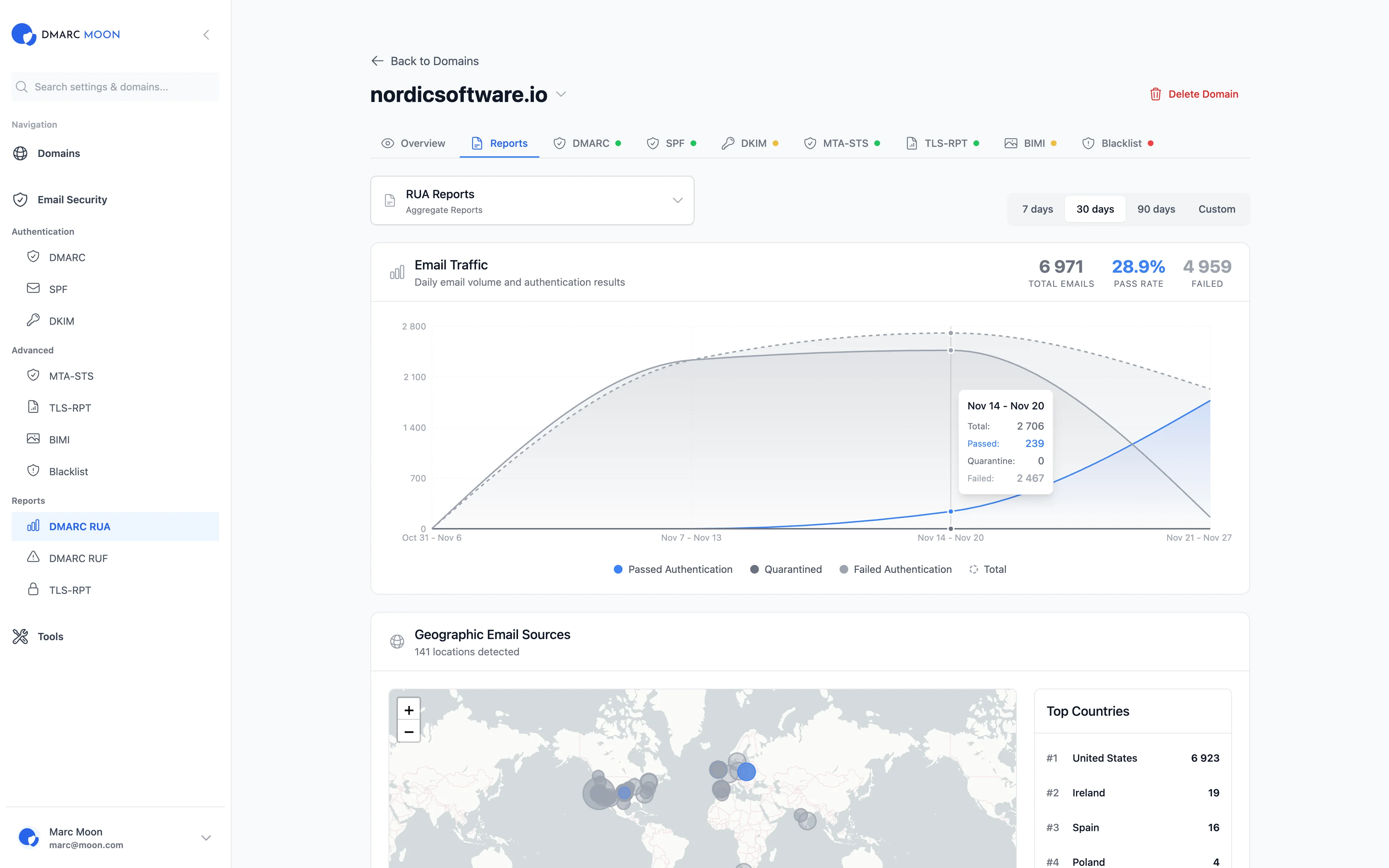
Impact: You can't fix what you can't see. DMARC reports help you identify and resolve deliverability issues you might never have found otherwise.
Learn how to use this visibility in our DMARC report analysis guide.
7. Stops Domain Spoofing
Domain spoofing—when attackers send emails that appear to come from your domain—hurts deliverability in multiple ways:
Scenario: Attackers send phishing emails pretending to be from your domain.
- Recipient Action: Recipients mark spoofed emails as spam
- Provider Response: Your domain gets associated with spam reports
- Result: Your legitimate emails start getting filtered
The Fix: DMARC with p=reject stops spoofed emails from being delivered, protecting your domain's reputation.
8. Improves Email Marketing ROI
For marketing teams, deliverability directly impacts ROI:
- Reach: More emails reaching inboxes = more potential opens
- Engagement: Better open rates = more conversions
- Consistency: Protected reputation = consistent performance over time
Impact: If 10% more of your marketing emails reach inboxes due to DMARC, that's a 10% increase in potential revenue from email marketing.
9. Supports Compliance Requirements
Many industries and regulations now require or recommend DMARC:
- PCI-DSS: Recommends email authentication for payment industry
- HIPAA: Healthcare organizations benefit from preventing spoofing
- Government: Many governments mandate DMARC (UK, US federal agencies)
- Financial Services: Banks increasingly require DMARC
Impact: Compliance isn't just about avoiding penalties—it signals to email providers that you take security seriously.
10. Future-Proofs Your Email Infrastructure
Email authentication standards continue to evolve:
- Google & Yahoo Requirements: Stricter requirements announced for bulk senders
- New Standards: ARC (Authenticated Received Chain) builds on DMARC
- Tighter Filtering: Email providers continue to raise the bar
Impact: Organizations with DMARC are prepared for these changes. Those without may face sudden deliverability drops as requirements tighten.
Common Deliverability Issues DMARC Helps Solve
Emails Going to Spam
Scenario: Your legitimate emails consistently land in spam folders.
- Root Cause: Missing or failing email authentication
- Spam Filter View: "Can't verify this sender is legitimate"
DMARC Solution: Proper authentication provides positive signals to spam filters. Passing SPF, DKIM, and DMARC tells filters your emails are legitimate.
Domain Blacklisting
Scenario: Your domain appears on email blacklists.
- Root Cause: Often caused by spoofed emails generating spam complaints
- Impact: Legitimate emails blocked by providers using that blacklist
DMARC Solution: Prevents spoofed emails that cause blacklisting in the first place. With p=reject, fake emails are blocked before they can generate complaints.
Inconsistent Delivery Rates
Scenario: Email delivery rates fluctuate unpredictably.
- Root Cause: Intermittent authentication failures or reputation damage from spoofing
- Impact: Hard to predict campaign performance
DMARC Solution: Consistent authentication leads to consistent deliverability. DMARC reports help you identify and fix issues before they impact delivery.
Brand Impersonation
Scenario: Attackers send phishing emails pretending to be your brand.
- Root Cause: No policy telling receivers to reject unauthenticated email
- Impact: Damages brand trust and may lead to your legitimate emails being treated with suspicion
DMARC Solution: Blocks emails that falsely claim to be from your domain, protecting your brand and maintaining recipient trust.
How to Implement DMARC for Better Deliverability
Follow this approach to maximize deliverability improvements:
Start with Monitoring (p=none)
Don't rush to enforcement. Use p=none to:
- Discover all your email sources through reports
- Fix authentication issues for each source
- Build a complete picture before enforcing
Ensure All Sources Are Authenticated
Every service sending email as your domain needs:
- SPF: Record entries for all sending IPs/services—check with our SPF lookup and create records with our SPF generator
- DKIM: Signing configured for each service—verify with our DKIM lookup
- Alignment: Domains matching for DMARC to pass
For detailed guidance, see our guides on SPF alignment and DKIM implementation.
Progress Gradually
Move through policy stages:
p=none— Monitoring, no impact on deliveryp=quarantine; pct=10— Gradual enforcement starting at 10%p=quarantine; pct=100— Full quarantine enforcementp=reject— Maximum protection
Learn more about this progression in our DMARC policies guide.
Monitor Continuously
Even after reaching p=reject, continue monitoring:
- New email sources need configuration
- Services change their sending infrastructure
- Authentication issues can emerge
Measuring Deliverability Improvements
Track these metrics before and after DMARC implementation:
- Inbox Placement Rate: Percentage of emails reaching inbox vs. spam
- Open Rates: Often improve as more emails reach inboxes
- Bounce Rates: Should decrease for authentication-related bounces
- Spam Complaints: May decrease as spoofing is blocked
- DMARC Pass Rate: Target 95%+ for legitimate email
FAQ
How quickly will I see deliverability improvements after implementing DMARC?
Timeline varies depending on your starting point:
- Authentication improvements: Immediate once properly configured
- Reputation recovery: Can take weeks to months if reputation was damaged
- Full benefits: Most organizations see significant improvement within 1-3 months of reaching enforcement
Start with p=none monitoring immediately—there's no downside and you begin collecting valuable data.
Will DMARC hurt my deliverability if I implement it wrong?
Only if you enforce before you're ready. That's why the gradual approach is critical:
p=nonehas zero impact on delivery—it only monitors- The
pcttag lets you test enforcement on a percentage of mail - Reports show you issues before they affect delivery
Following the progressive implementation approach eliminates risk.
Do I need DMARC if my deliverability is already good?
Yes. Good deliverability without DMARC is vulnerable:
- Your domain could be spoofed at any time, damaging reputation
- Major providers are increasingly requiring authentication
- Google and Yahoo announced stricter requirements for bulk senders
- BIMI (logo in inbox) requires DMARC enforcement
DMARC protects your current good deliverability and positions you for future requirements.
How does DMARC work with email marketing platforms?
Email marketing platforms send email on your behalf, so they need proper authentication:
- SPF: Add the platform's include statement to your SPF record
- DKIM: Configure custom DKIM signing through the platform's settings
- Return-Path: Set up a custom return-path domain for SPF alignment
Most major platforms (Mailchimp, HubSpot, SendGrid, etc.) support all of these. Check their documentation for "custom domain authentication" or "branded sending."
What's the relationship between DMARC and sender reputation?
DMARC protects sender reputation in two ways:
Direct protection:
- Stops spoofed emails from reaching recipients
- Prevents spam complaints from fake emails
- Blocks phishing attacks using your domain
Indirect benefits:
- Authentication is a positive signal to providers
- Shows you're a responsible sender
- Builds trust over time
Can DMARC fix deliverability problems caused by other issues?
DMARC addresses authentication-related deliverability issues. It won't fix:
- Content issues: Spammy subject lines, suspicious links
- List quality: Sending to invalid or unengaged addresses
- Sending behavior: Volume spikes, inconsistent sending patterns
- IP reputation: Issues with shared sending infrastructure
DMARC is one component of a comprehensive deliverability strategy, but it's an increasingly essential one.
What percentage of emails should pass DMARC?
Target: 95%+ for legitimate email sources.
Some failures are expected and acceptable:
- Forwarded emails often fail SPF (expected)
- Mailing list software may break DKIM (expected)
- Legacy systems may not support authentication (needs fixing)
Focus on ensuring your known legitimate sources all pass. Unknown sources failing is often a good thing—it means your policy is blocking potential spoofing.
Ready to Improve Your Email Deliverability?
DMARC Moon helps you implement DMARC for maximum deliverability:
- Easy setup with guided implementation
- Comprehensive monitoring of all email sources
- Clear visibility into authentication status
- Actionable recommendations to fix issues
- Progress tracking toward full enforcement